News Story
UMD Research to be Published in Science

Multiple ferroic orders squeezed into 2D materials at ambient conditions by Professor Cheng Gong’s research
A paper by a group of UMD researchers and collaborators, titled Room-temperature Multiferroicity in All-van der Waals Heterostructures, is published in the August 2026 edition of the scientific journal Science. The lead researcher working on this paper is Professor Cheng Gong. UMD-affiliated authors are Qingqin Wang, Mario Lopez, and Efrain Rodriguez.
What people can learn from basic physics and life experience
One of the fundamental laws of physics learned in high school is the Second Law of Thermodynamics, which implies that an isolated system tends to become chaotic. This is the so-called entropy increasing tendency, as for example reflected in the aging process human beings are experiencing daily. Such a tendency becomes even stronger in two-dimensional (2D) systems. A vivid example is if you hold a page of thin paper sheet at hand in the air, it can hardly stay flat without being rippled or deformed. In 1966, two scientists rigorously derived the classic Mermin-Wagner theorem - in a nutshell, 2D systems with a continuous symmetry cannot be ordered.
Long-range magnetic order in 2D systems being threatened
In 2017, Gong and his collaborators reported the experimental observation of long-range magnetic order in a 2D material for the first time [Nature 2017, Science 2019].
“Continuous symmetry should be broken to support the long-range magnetic order in 2D systems to battle against thermal fluctuations at non-zero temperatures”, explained Gong, “just like the rippled paper sheets or the hand-supported ones. These sheets of imperfect flatness lose the continuous symmetry. They can be stable, as when you rotate them, they become unlike before”. By giving a specific magnetic ordering orientation, the continuous symmetry is broken, and by doing so, Gong and his collaborators discovered long-range magnetic order in 2D materials.
Long-range dipole order in 2D systems being threatened
Another technologically relevant order is the order of electric dipoles. In a crystal of periodically positioned atoms, if the center of positively charged ions (e.g., metal ions) and the center of negatively charged ions (i.e., oxygen ions) are not overlapped, the material possesses a net dipole, a spontaneous electric polarization. Interestingly, the positions of the positive and negative charges can be switched by a voltage, causing all the electric dipoles in the materials to be switched collectively. Materials, with inherent electric dipoles that can be collectively switched back and forth by voltages of opposite signs and remain there after power is shut off, are known as ferroelectrics.
However, because positive and negative charges like to draw near each other, particularly while they are not far apart, such an electric polarization becomes increasingly unstable when a ferroelectric becomes ever thinner. In short, long-range ferroelectric order tends to be unstable in 2D systems, like the fate of long-range ferromagnetic order in 2D systems.
Can ferro-magnetic order and ferro-electric order coexist in a 2D system to cause 2D multi-ferroics? Even at room temperature? Why is it important?
“Realizing one order in a 2D system was already a challenge. Realizing two orders simultaneously in a 2D system is even more challenging. The ensuing challenge of making such a realization at room temperature would be imaginably tremendous. Yet, I always stressed that, though it’s hard, it is not impossible.” remarked Gong, “the reward would be also far-reaching. Once ferromagnetic order and ferroelectric order coexist in a 2D material, it is a 2D multiferroic. It would allow people to use small electric voltages to easily reconfigure the positions of charged ions in the ferroelectric component, thereby producing the energy-efficient, reconfigurable control of ferromagnetic properties. This directly underpins energy-efficient data storage that potentially quenches the energy thirst of the AI era.”
Before undertaking the streak of experimental efforts on this research agenda, Gong and his collaborators had carried out the initial theoretical exploration, trying to understand how the ferroelectric and ferromagnetic order could interplay, based on a hypothetical model of material system they built on the computer, published in Nature Communications 2019.
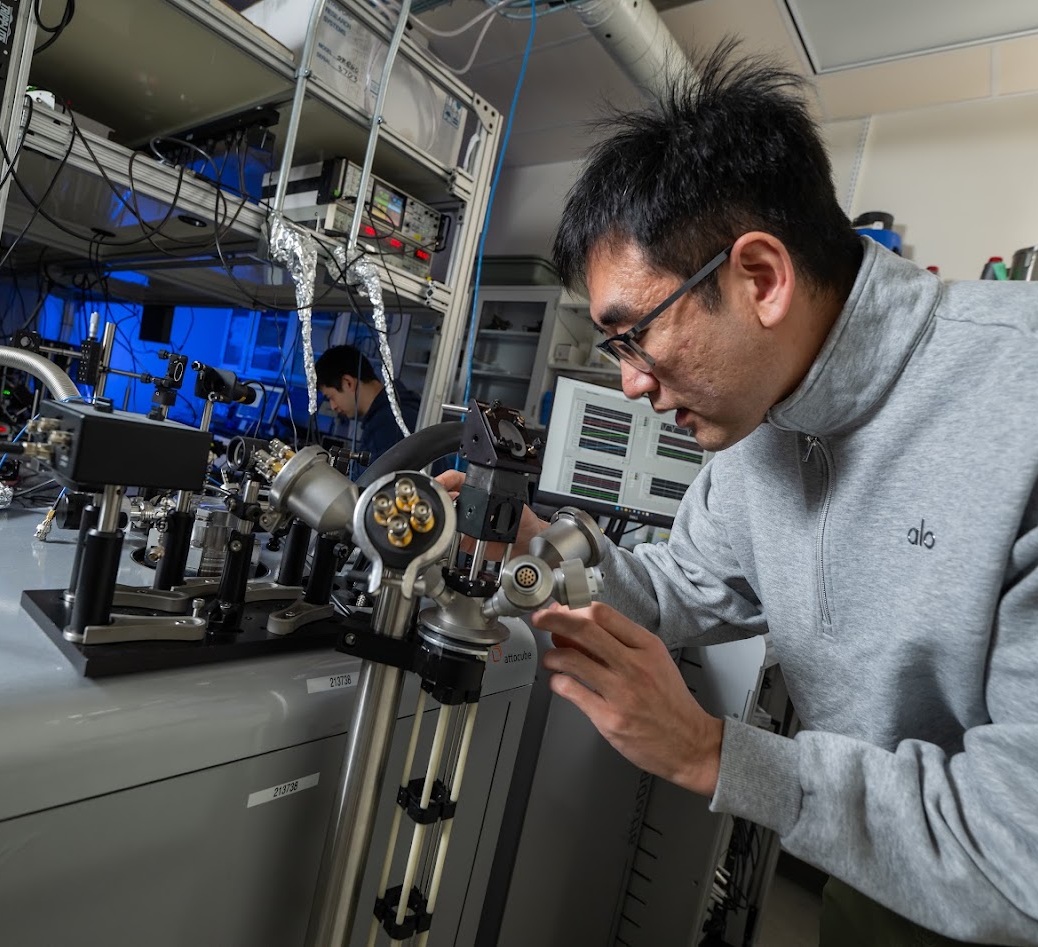 An earlier experimental study performed by Gong’s research group and collaborators (with Gong’s former Ph.D. student Shanchuan Liang as the first author), published in Nature Electronics 2023, demonstrated the ferroelectric control of 2D magnetism. Yet, this development was based on a polymer ferroelectric. Recently, published in Nature Electronics 2026, Gong’s team continued to demonstrate magnetoelectric multiferroics by bringing together a 2D ferroelectric and a 2D ferromagnet. The limit was, this was still at the low temperature of 153K (-184F), which is approximately 140K below room temperature (with room temperature being measured at approximately 68F).
With the trio (i.e., 2D ferromagnets, 2D ferroelectrics, and 2D ferromagnets)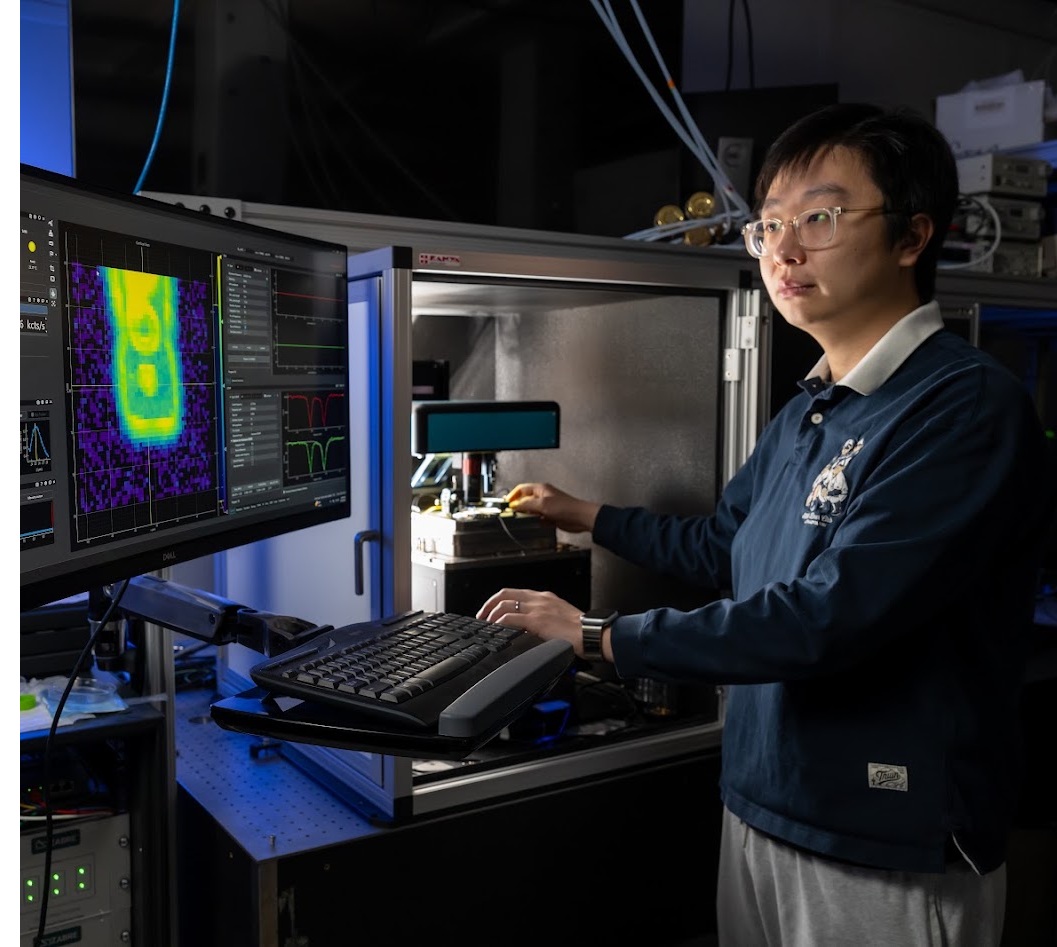 coming together to form a sandwich structure, Gong’s team and collaborators have developed the one-of-a-kind device: all van der Waals multiferroic tunnel junction, published in Nature Nanotechnology 2026 (with Gong’s postdoctoral researcher Ti Xie as the first author). By controlling the ferromagnetic and ferroelectric polarizations, respectively, this device exhibits four distinct states of electrical resistance, which potentially propel unconventional computing beyond the conventional binary states. This multi-state non-volatile (i.e., information is retained on computers even without power) memory just marks an exemplary device that 2D multiferroics could bring on the table for futuristic information technologies.
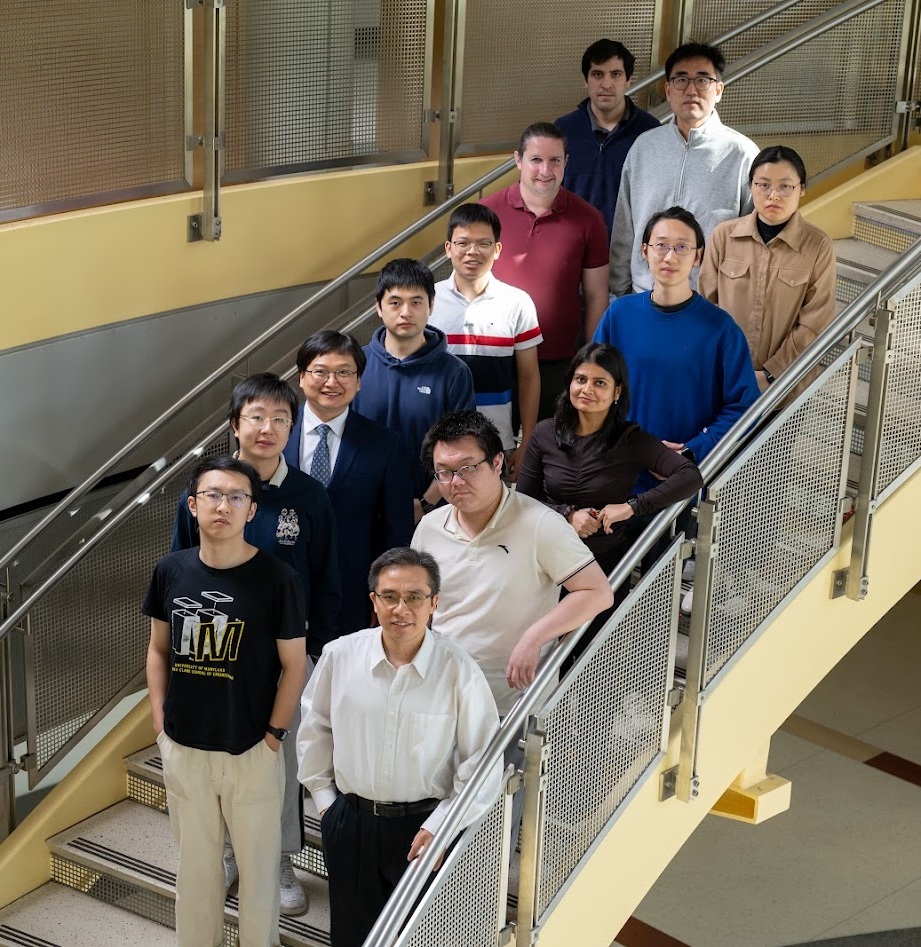
Cheng Research Group: Front row bottom to top: Professor Cheng Gong, Mr. Kaixin Zou, Dr. Rosalin Mohanty, Dr. Linfeng Ai, Dr. Qinqin Wang. Back Row bottom to top: Mr. Yixao Wang, Dr. Ti Xie, Dr. Kwangsu Kim, Dr. Siwei Chen, Dr. Yuwei Sun, Dr. Richard A. Escalante, Dr. Camron Farhang, Dr. Shanchuan Liang
Years of collective and persistent efforts have culminated in this work, just published in Science 2026 (with Gong’s postdoctoral researcher Qinqin Wang as the first author), where the group’s ground-breaking discovery showed room-temperature multiferroics in 2D systems for the first time. This is a milestone in fundamental science, with abundant technological prospects, because it demonstrates that both ferromagnetic order and ferroelectric order can resist the escalating thermal fluctuations at room temperature to survive together in a 2D system, which sheds immediate light on practical devices. The nature of 2D grants any forthcoming multiferroic devices the perceivable promise in footprint miniaturization, high-density integration, and ultralow energy consumption. This type of platform is poised to blaze the trail for energy-efficient high-density data storage, nowadays urgently needed for AI data centers.
“Together, we are marching onward into an uncharted territory, aiming to study unexplored phenomena, reveal new knowledge, and develop critical devices.” remarked Gong, “ The rich set of collective phenomena tied to the multi-order low-dimensional systems are profound and curiosity-provoking. I believe much more will unfold soon, in the ways expectedly and unexpectedly.”
Gong team’s multiferroic related research was and is generously supported by National Science Foundation (NSF), Air Force Office of Scientific Research (AFOSR), Office of Naval Research (ONR), Defense Threat Reduction Agency (DTRA), Defense Advanced Research Projects Agency (DARPA), National Security Agency (NSA)/Laboratory Physical Sciences (LPS), The United States Congress, Army Research Laboratory (ARL), Naval Air Warfare Center Aircraft Division (NAWCAD), Northrop Grumman (NG), Intel, Micron, Samsung, and the University of Maryland.
Published August 13, 2026
Recent Stories
Stories / Oct 5, 2026
Shah Lab Advances Ferroelectric-Based Neuromorphic Hardware for...

Stories / Oct 5, 2026
UMD Team Secures $200,000 to Commercialize Wearable Vascular...

Stories / Oct 5, 2026
Celebrating LGBTQ+ History Month 2026

Stories / Sep 22, 2026
Two Years Running, Maryland #12 Among Publics for Undergrad...

Stories / Sep 21, 2026
Wu Receives IEEE Sensors Council Technical Achievement Award

Stories / Sep 17, 2026
Four ECE Alums to be Honored by A. James Clark School of...

Stories / Sep 15, 2026
When AI Goes on Defense

Stories / Sep 14, 2026
Project, Problem, Solution: MATRIX Interns Make an Impact

Stories / Sep 14, 2026
Two New Faculty Members Welcomed to ECE

Stories / Sep 11, 2026
ECE Announces 2026 Annual Awards with Ceremony and Reception
